
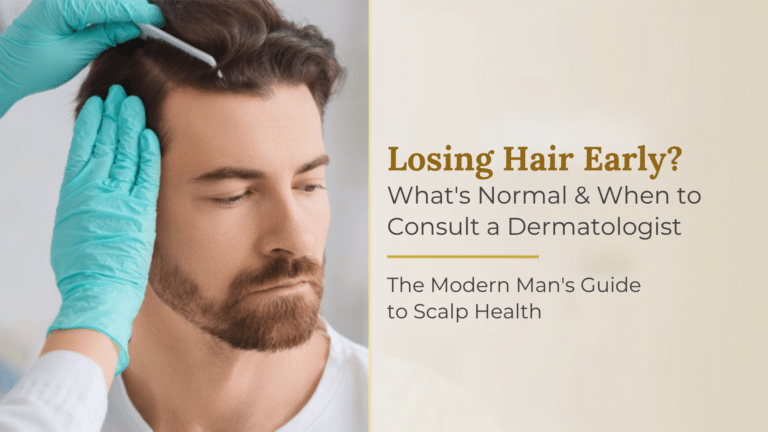
Noticing more hair on the pillow or shower drain? Or are your friends joking about “going botak”? Hair loss and scalp issues are one of the most common health concerns that men face, and can begin as early as the 20s. Not all hair loss is permanent, and some conditions are treatable with early intervention.
Before jumping to conclusions at the sight of hair in the shower drain, it helps to understand how the hair cycle works. Every hair follicle on your scalp grows independently across three main phases:
Anagen:The active growth phase, lasting two to seven years.
Catagen:A brief, transitional phase lasting a couple of weeks.
Telogen:A resting phase lasting a few months, culminating in the hair shedding so a new one can grow.
Because of this constant cycle, losing 50 to 100 hairs a day is entirely normal.

When hair thinning goes beyond standard daily shedding or a maturing hairline, it generally falls into a few primary categories of non-scarring alopecia.

Commonly known as male pattern baldness, this is the most prevalent form of hair loss in men, affecting roughly 30% to 50% of men by the age of 50.
If you notice your hair coming out in sudden, alarming clumps rather than a slow, years-long recession, you may be experiencing Telogen Effluvium.
Healthy hair cannot grow from an inflamed, unhealthy foundation. Many men mistake chronic inflammatory conditions for simple “dry skin”, leading to improper treatment that can exacerbate hair shedding. Chronic work stress, poor sleep, the heat and humidity in Singapore, poor dietary and lifestyle habits as well as the use of frequent styling and hair/scalp treatment products can all compound to result in an irritated and inflamed scalp.

These two conditions exist on the same continuous spectrum of skin inflammation. They are primarily driven by an inflammatory response to an overgrowth of Malassezia, a harmless yeast that naturally lives on everyone’s skin and feeds on sebaceous (oil) secretions.
Often confused with severe seborrheic dermatitis, scalp psoriasis is a distinct autoimmune condition where skin cells multiply far too quickly. It is characterized by raised, sharply defined plaques covered in thick, powdery, silvery-white-pink scales. Unlike seborrheic dermatitis, it can extend past the hairline as a solid plaque and may be accompanied by characteristic “pitting” on your fingernails or joint pain.
This is a result of a fungal infection on the scalp, it can be infectious and is treatable with topical antifungals but often also requires oral antifungal treatment.
Seek a specialist dermatologist consult if you experience any of the following:
Early and accurate assessment allows for appropriate treatment options and better long-term management. Some suggestions for first line treatment include:
Condition | Primary First-Line Interventions | Active Ingredients to Look For |
Male Pattern Baldness | • Topical or oral minoxidil (promotes blood flow/extends growth cycle) • Oral finasteride (blocks the conversion of testosterone to DHT) | • Minoxidil • Finasteride |
Dandruff & Seb Derm | • Medicated over-the-counter shampoos used 2–3 times weekly during the treatment phase • Avoid applying heavy raw oils which feed the yeast | • Ketoconazole • Zinc Pyrithione • Selenium Sulfide |
Scalp Psoriasis | • Targeted topical anti-inflammatory solutions • Scale-softening agents | • High-potency topical corticosteroids • Salicylic acid (for descaling) |
References
Borda, L. J. (2016). Seborrheic Dermatitis and Dandruff: A Comprehensive Review. Journal of Clinical and Investigative Dermatology, 3(2)
Iyengar, L. (2025). Male and female pattern hair loss. Australian Prescriber, 48,12187474
Kaliyadan, F., Nambiar, A., & Vijayaraghavan, S. (2013). Androgenetic alopecia: An update. Indian Journal of Dermatology, Venereology, and Leprology, 79(5), 613-625. https://doi.org/10.4103/0378-6323.116730 Indian Journal of Dermatology, Venereology and Leprology
Bolognia, J. L., Schaffer, J. V., & Cerroni, L. (2025). Dermatology (Fifth edition.). Elsevier. Chicago Style
If you have been experiencing hair loss or scalp concerns, struggling with shedding, thinning, or flare-ups, you do not have to navigate it alone.
We are here to help.