
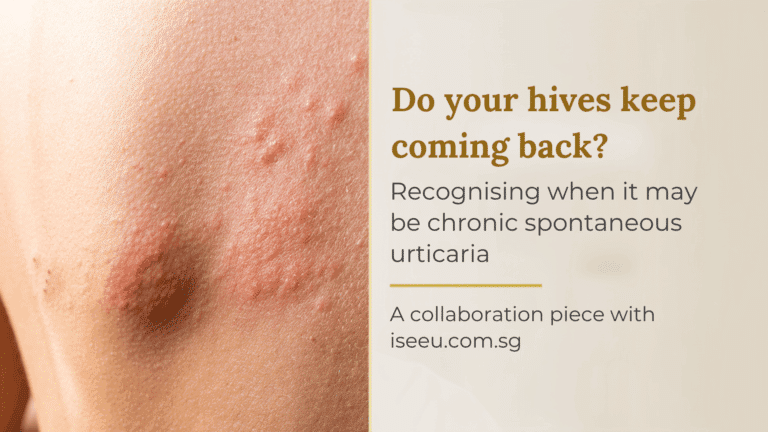
When hives seem to appear repeatedly without warning, it’s common to think back over the day and ask: Was it something I ate? Something I touched? Something in the environment? Dr Laura Hui, Consultant Dermatologist and Medical Director at Auria Dermatology, answers common questions about recurring hives and explains when they may be a sign of chronic spontaneous urticaria (CSU).
Dr Hui says many patients come to clinics convinced that there must be an underlying cause. In her experience, many initially suspect a food allergy and may even begin avoiding foods such as seafood to identify a trigger.
For Dr Hui, however, identifying a possible trigger is only part of the picture. She also considers how symptoms present and have behaved over time. Immediate allergic reactions usually develop within minutes to hours of exposure to a specific allergen and tend to be reproducible, meaning the same exposure generally causes the same reaction each time.1
Dr Hui notes that if your symptoms continue for six weeks or longer, often without a clear trigger, they may be a sign of chronic spontaneous urticaria (CSU), a chronic skin condition characterised by recurring hives, deep tissue swelling (angioedema), or both; and this can be understandably frustrating for most patients as there can be a lack of a clear trigger.2
According to Dr Hui, there are several signs to look out for:
Dr Hui acknowledges that CSU can be difficult to recognise because symptoms come and go and may not always be visible during a medical appointment, contributing to delays in diagnosis.4 Recognising that your hives are recurring, rather than isolated episodes, can help you seek the right assessment sooner.
Dr Hui recommends speaking to your doctor if:
If your symptoms are not visible during your appointment, photographs of flare-ups, a timeline of when they occur, and notes on how they affect your sleep or daily activities, as well as a diary attempting to record and keep track of any associated triggers can help your doctor understand the overall pattern and impact of your symptoms.5
Your dermatologist can help determine whether the symptoms you are experiencing are consistent with CSU or another condition and advise on the most appropriate next steps to help you manage your symptoms.
References
Santos AF, Riggioni C, Agache I, et al. EAACI guidelines on the diagnosis of IgE-mediated food allergy. Allergy. 2023;78:3057-3076. doi:10.1111/all.15902.
Zuberbier T, Ansari ZAH, Abdul Latiff AH, et al. The international guideline for the definition, classification, diagnosis and management of urticaria. Allergy. 2026;1-51. doi: 10.1111/all.70210
Kolkhir P, Giménez-Arnau AM, Kulthanan K, et al. Urticaria. Nat Rev Dis Primers. 2022;8:61. doi:10.1038/s41572-022-00389-z.
Friedman A, Kwatra SG, Yosipovitch G. A practical approach to diagnosing and managing chronic spontaneous urticaria. Dermatol Ther (Heidelb). 2024 Jun;14(6):1371-1387. doi: 10.1007/s13555-024-01173-5
Weller K, Winders T, McCarthy J, Raftery T, Saraswat P, Constantinescu C, Balp MM, Bernstein JA. Urticaria Voices: Real-World Experience of Patients Living with Chronic Spontaneous Urticaria. Dermatol Ther (Heidelb). 2025 Mar;15(3):747-761. doi: 10.1007/s13555-025-01348-8. Epub 2025 Feb 28. PMID: 40019716; PMCID: PMC11909366.
FA-11771626 | 25 Aug 2026
If you have been experiencing hair loss or scalp concerns, struggling with shedding, thinning, or flare-ups, you do not have to navigate it alone.
We are here to help.